
A strong core isn’t just for athletes. It’s essential for older adults who want to stay independent, avoid falls, and move with confidence. For seniors over 60, traditional crunches and planks can do more harm than good, increasing spinal compression and risking injury. The truth is, effective stomach exercises for elderly individuals focus less on appearance and more on functional stability, balance, and safe movement.
Modern senior fitness research shows that dynamic, controlled exercises, performed seated or standing, are far more beneficial than floor-based crunches. These movements engage the deep abdominal muscles (especially the transverse abdominis), support posture, reduce back pain, and improve daily mobility like standing up from a chair or walking up stairs. With just 10 minutes a day using only a sturdy chair or wall, seniors can build a resilient core that protects the spine and enhances quality of life.
This guide delivers a complete, safe, and science-backed approach to core training for older adults. You’ll learn the best seated, standing, and modified floor exercises, how to breathe correctly, avoid common mistakes, and follow simple routines that fit any fitness level, even if you’re recovering from injury or have limited mobility.
Seated Core Activation First

Starting your core workout in a chair is smart and safer. It reduces fall risk, supports balance, and allows precise control over movement. Seated exercises are ideal for beginners, those with joint issues, or anyone new to strength training.
The goal isn’t speed or high reps. It’s engagement. Each motion should activate the deep abdominal muscles while maintaining a long spine and steady breath. Begin every session with foundational activation to “wake up” your core.
Lengthen and Engage the Spine
Sit at the front edge of a sturdy, non-rolling chair. Keep feet flat on the floor, knees hip-width apart. Place hands across your chest or lightly behind your head. Never pull on your neck.
Inhale to prepare. As you exhale, gently draw your belly button toward your spine and sit taller, as if a string is lifting your head toward the ceiling. Avoid shrugging shoulders. Keep them relaxed and down.
Now, lean back slightly, just a few inches, while keeping your spine long. Do not round forward or collapse your chest. Inhale here. Then, as you exhale again, use your lower abs to return to upright.
This small rocking motion teaches your body to use the core, not momentum. Focus on feeling the center of your belly tighten with each return.
Tip: If you feel strain in your lower back, reduce the range of motion. Even a tiny movement with perfect form builds strength.
Lift Legs Without Lower Back Strain
Once your core is engaged, progress to leg movements that challenge stability without stressing the spine.
Bring your feet slightly inward, hands resting on thighs. Keep your spine tall and core tight. Instead of lifting legs high, simply lift one foot at a time onto tippy toes, alternating sides.
Move slowly. No bouncing. The goal is pelvic control, not height. You should feel your lower abs and hip flexors working.
If this feels easy, try seated marching: slowly lift one knee a few inches toward your chest, then lower with control. Repeat on the other side. Keep your back straight and avoid leaning forward.
Common mistake: Letting the lower back arch. If you feel pressure there, place a pillow behind your lumbar curve for support or reduce the lift height.
Twist with Control, Not Force
Spinal rotation is part of daily life: reaching for the seatbelt, turning to check traffic, or grabbing something from the back seat. But uncontrolled twisting can lead to injury.
The seated spinal twist builds safe rotational strength. Sit tall, hands crossed in front of your chest or lightly behind your head. Gently rotate your upper body to the right, keeping hips facing forward. Hold for a second, return to center, then twist left.
Keep movements small and smooth. Your gaze can follow your hands, but don’t jerk your neck.
Pro tip: If balance is a concern, keep one hand on the armrest or seat for light support.
Standing Exercises for Real-Life Strength

Standing core work mimics how you actually use your body: walking, reaching, bending, and balancing. These exercises build functional strength that translates directly to daily independence.
Always warm up first: march in place for 30 seconds, lifting knees gently while engaging your abs. Add 3 overhead reaches (inhale as arms rise, exhale as they lower) to prepare your spine and breathing.
Use a chair, countertop, or wall for balance if needed. Never push through wobbling or pain.
Lift Knees with a Stable Torso
Knee ups strengthen lower abs and hip flexors. Stand with feet hip-width apart, core engaged. Slowly lift one knee toward your chest, only as high as you can without leaning back or arching your spine.
Lower with control. Repeat on the other side.
Key cue: Keep your pelvis still. If your lower back sways, reduce the lift height. This isn’t about how high you go. It’s about control.
Do 10 reps per side, 2–3 times per week.
Move Arms, Not Your Trunk
Press outs train your obliques to stabilize while your limbs move, exactly what happens when you carry groceries or reach for a shelf.
Stand with a slight knee bend, hands together at chest level. Press one hand straight out to the right, then return to center. Press to the left, return.
Your torso should stay completely still. Only your arms move. Draw your belly button in throughout.
Do 10 full cycles (right, center, left, center).
Why it works: This teaches anti-rotation. Your core resists movement, which is critical for fall prevention.
Hinge and Reach Without Swaying
The hip hinge is one of the most important movements for seniors. It protects your back when you bend down and supports lifting safely.
Stand feet hip-width, soft knees. Hinge forward at the hips (not the waist), reaching one hand toward the opposite knee. Keep your back flat. No rounding.
Return to standing tall. Alternate sides.
This engages the posterior core and teaches proper mechanics. If balance is shaky, perform near a wall for light fingertip support.
Do 10 total reps.
Warning: If your hips shift side to side, slow down. Stability matters more than range.
Modified Floor Work for Safer Core Challenges
If you can safely get down to the floor, these modified exercises build deep core control with minimal spinal load. But never force it. If getting up is difficult, stick to seated or wall-based options.
Climb the Wall, Not the Floor
Traditional planks compress the spine and often lead to poor form in seniors. The wall mountain climber is a safer, more functional alternative.
Face a flat wall. Place hands on it at shoulder height. Step back until your body forms a diagonal line from head to heels. Engage your core, belly button to spine.
Slowly bring one knee toward your chest, then return. Alternate legs. Move slowly: 1 second in, 1 second out.
Keep your lower back stable. No arching or bouncing.
Progression: When this feels easy, try the chair mountain climber (hands on a sturdy chair seat, increasing the angle). Only move to the floor version if strength and balance allow.
Do 3 sets of 20 reps.
Hold a Chair Plank Safely
If you want to try a plank, use a chair plank to reduce strain.
Kneel on the floor, forearms on a sturdy chair seat (or table). Body should form a straight line from head to knees. Squeeze your glutes and engage your core.
Hold for 15–20 seconds. Breathe steadily. Do not hold your breath.
Stop immediately if your lower back sags or you feel shoulder pain.
Start with 2–3 sets. Only progress to a full floor plank if you can maintain perfect form.
Try the Dead Bug for Deep Stability
The dead bug is one of the best floor exercises for seniors. It strengthens the core without loading the spine.
Lie on your back, knees bent 90 degrees, arms straight up. Flatten your lower back slightly into the floor.
Engage your core. Slowly extend your right arm overhead and left leg straight out, hovering just above the floor. Hold 1 second, return.
Repeat on the opposite side (left arm, right leg).
Critical: If your lower back lifts off the floor, stop. Place a hand under your lumbar curve. If it gets pushed out, the movement is too advanced.
Do 3 sets of 10–12 reps per side, 3 times per week.
Benefit: This trains your core to stabilize while limbs move, exactly what prevents falls during daily tasks.
Build a Routine That Fits Your Life
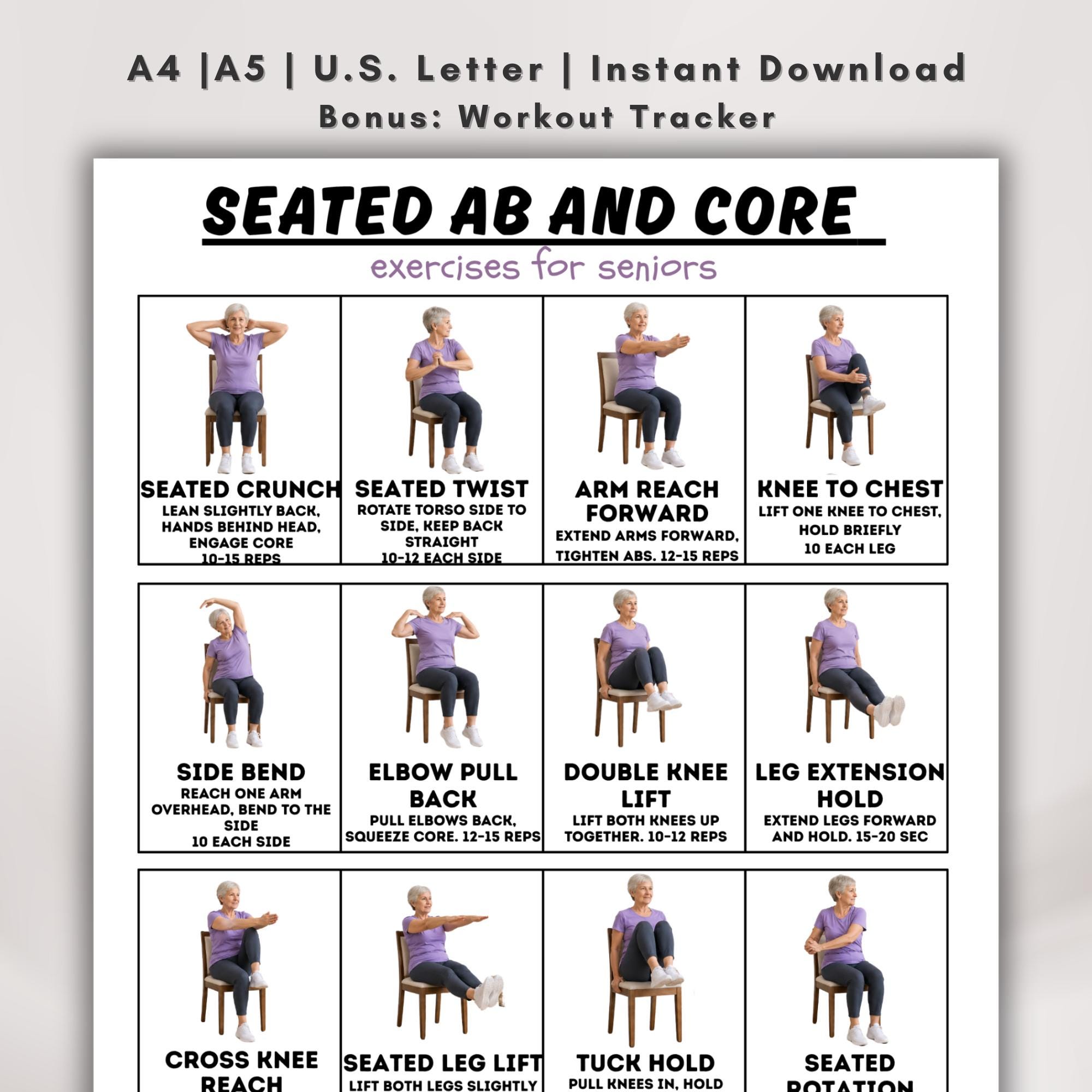
You don’t need hours in the gym. Just 10 minutes a day, 3 times a week, can transform your core strength and stability.
Choose the routine that matches your mobility and goals.
10-Minute Seated Routine for Beginners
Perfect for those with limited mobility, recovering from injury, or new to exercise.
- Spine Lengthening & Core Activation – 6–8 reps
- Alternating Leg Lifts – 8–10 per side
- Seated Marching – 10 per leg
- Seated Spinal Twists – 6–8 total
- Seated Sit-Ups – 6–8 reps (lean back slightly, sit up using core)
- Knee-to-Chest Twists – 6 per side
- Arm & Torso Twists – 6 per side
- Chair Sit-to-Stands – 8–10 reps (no hand push)
Finish with 3 deep breaths and an overhead reach.
Standing Functional Flow for Daily Independence
Ideal for improving balance, posture, and real-world strength.
- March in Place + Overhead Reaches – 30 sec + 3 reps
- Knee Ups – 10 per side
- Press Outs – 10 total
- Hinge with Opposite Knee Touch – 10 total
- Diagonal Reach and Fist – 10 reps
- Side Bends – 10 per side
- Standing Leg Lifts – 10 per leg (hold chair)
- Standing Cat-Cow – 3 reps
Finish with a side stretch (5 sec per side).
Two-Exercise Power Session for Efficiency
For those who want maximum benefit in minimal time.
- Wall Mountain Climber – 3 sets of 20 reps
- Dead Bug or Double Leg Lift – 3 sets of 10–12 reps per side
Do this 3 times per week. It’s enough to build serious functional strength.
Breathe Right, Move Better

Proper breathing isn’t optional. It’s the key to safe, effective core engagement.
Rule: Inhale during preparation, exhale during exertion.
- When sitting up: exhale
- When lifting a leg: exhale
- When twisting: exhale
- When reaching: exhale
This pattern activates the transverse abdominis, the deep core muscle that acts like a natural weight belt. It also prevents dangerous blood pressure spikes from holding your breath (Valsalva maneuver).
Test: If you can’t say a short sentence while exercising, you’re holding your breath or pushing too hard.
Avoid These Common Mistakes
Even small errors can turn a safe exercise into a risk.
Arching the Lower Back
This is the number one red flag. In floor or seated lifts, if your lower back lifts off the floor or sways, stop. You’ve lost core control.
Fix: Reduce range of motion, engage belly button to spine, or place a hand under your back to monitor pressure.
Pulling on the Neck
Never use your hands to yank your head forward during sit-up variations. This strains the neck and shifts focus from the abs.
Fix: Cross hands over chest or place fingertips lightly behind ears. Use core, not arms.
Using Momentum
Bouncing, jerking, or swinging kills muscle engagement and increases injury risk.
Fix: Move in slow motion. Take 2–3 seconds for each phase.
Ignoring Pain
Muscle fatigue is normal. Sharp pain in the back, hips, or joints is not.
Rule: If it hurts, stop. Modify or skip the exercise.
Frequently Asked Questions About Stomach Exercises for Elderly
Are stomach exercises safe for seniors with back pain?
Yes, when done correctly. Focus on seated and standing exercises that engage the deep core without compressing the spine. Avoid traditional crunches and planks if back pain is present, and always keep a neutral spine throughout movements.
How often should elderly people do core exercises?
Three times per week is ideal for most seniors. Beginners can start with 10-minute daily seated sessions. Allow rest days between more intense routines like dead bugs or mountain climbers to prevent fatigue and injury.
Can seniors build core strength without getting on the floor?
Absolutely. Seated and standing exercises can build significant core strength. Chair-based routines engage the deep abdominal muscles effectively, making them perfect for those with limited mobility or balance concerns.
What is the best exercise for a weak core in older adults?
The wall mountain climber paired with the dead bug is highly effective. These dynamic movements train the core to stabilize while limbs move, which mirrors real-life activities and prevents falls.
How long does it take to see results from senior core exercises?
Most seniors notice improved posture and balance within 2–4 weeks of consistent practice. Significant strength gains typically appear after 6–8 weeks of regular training, 3 times per week.
Should seniors avoid planks completely?
Traditional floor planks can compress the spine and aren’t ideal for most older adults. However, modified versions like the chair plank or wall plank offer similar benefits with much less spinal load and injury risk.
Key Takeaways for Safe Stomach Exercises for Elderly

Core strength is foundational to aging well. It supports posture, prevents falls, eases back pain, and helps you stay active, whether you’re gardening, playing with grandkids, or simply getting out of a chair.
The best stomach exercises for elderly adults aren’t about six-packs or high reps. They’re about control, stability, and function. Start where you are. Use a chair. Breathe deeply. Move slowly. Focus on form, not speed.
With consistent practice, just a few times a week, you’ll build a stronger, more resilient core that supports every move you make.
Final Tip: Pair these exercises with daily walking and light resistance training for full-body strength. Your core is the center of everything. Protect it, strengthen it, and live with greater freedom.