Losing strength with age doesn’t have to mean losing independence. For adults over 65, dumbbell exercises for elderly individuals offer a proven way to maintain mobility, prevent falls, and preserve the ability to handle daily tasks like climbing stairs, carrying groceries, or standing from a chair. Research shows that consistent, properly executed resistance training can reverse age-related muscle loss, improve balance, and enhance overall quality of life.
The key lies in using light to moderate dumbbells with perfect form and focusing on functional movements that mimic real-life actions. This guide delivers science-backed routines, safety protocols, and step-by-step techniques tailored for seniors seeking strength, stability, and confidence. You’ll learn how to build full-body strength safely, avoid common injuries, and integrate these exercises into a sustainable weekly routine.
Build Functional Lower Body Strength for Daily Independence

Strengthening the legs is essential for fall prevention and mobility. These dumbbell exercises target the muscles used for walking, standing, and stair climbing, all critical for maintaining independence as you age.
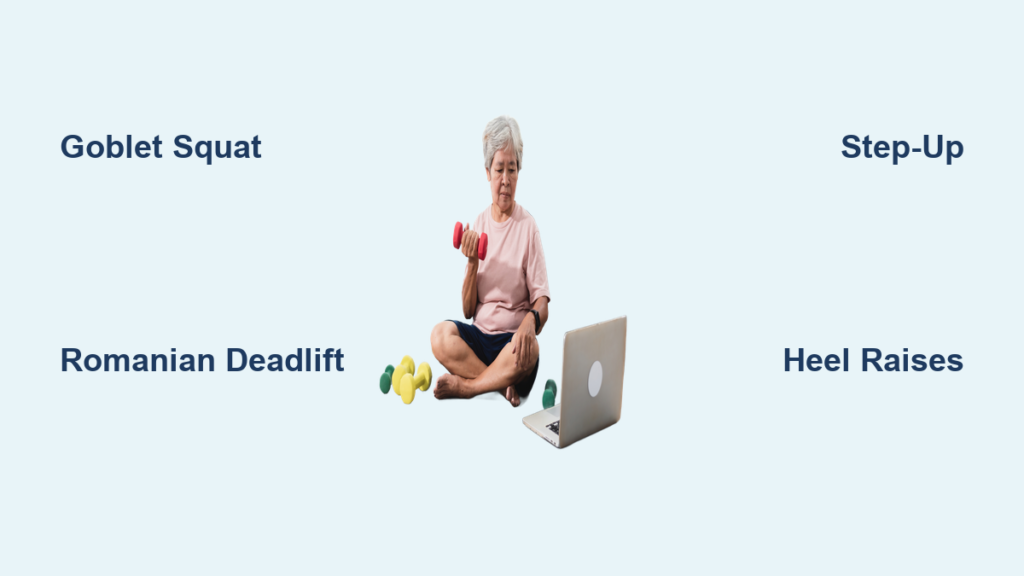
Master the Goblet Squat Progression
The goblet squat builds leg strength and teaches safe hip and knee mechanics. It mimics sitting and standing, making it one of the most functional movements for seniors.
Beginner: Goblet Sit-to-Stand
Hold a light dumbbell at chest level with both hands. Sit on the edge of a sturdy chair placed against a wall. Slowly lower yourself until you lightly touch the seat, then stand up using your legs, not your arms. This version builds confidence and control.
Tip: Keep your chest up and weight in your heels to protect knees.
Intermediate: Full Goblet Squat
Remove the chair. Hold the dumbbell close to your chest, elbows pointing down. Lower into a squat, keeping your back straight and knees tracking over toes. Go as low as comfortable, aiming to reach thigh parallel to the floor. Push through your heels to return.
Focus: Maintain a neutral spine and avoid letting knees cave inward.
Advanced: Pulse Goblet Squat
After a full squat, rise halfway, lower back down, and pulse at the bottom for 2 to 3 reps before standing. This increases time under tension and deeply activates quads and glutes.
Use only if balance and joint stability are strong.
Protocol: 10 to 20 reps × 3 sets, 1 to 2 minutes rest.
Perform Romanian Deadlifts Safely
The Romanian deadlift strengthens the hamstrings and glutes while teaching proper hip hinging, which is essential for lifting objects safely and protecting the lower back.
Stand with feet hip-width apart, holding light dumbbells in front of your thighs. Keep a slight bend in your knees. Push hips back while keeping your spine long and flat. Never round your back. Lower weights down your legs until you feel a stretch in your hamstrings. Return by squeezing glutes and driving hips forward.
Tempo: 4 seconds down, 2 seconds up for maximum control.
Common Mistake: Bending at the waist instead of hinging at the hips. Practice in front of a mirror to check form.
Protocol: 8 to 15 reps × 3 sets.
Step-Up for Stair Climbing Power
This exercise directly improves the ability to climb stairs, a key indicator of functional fitness in older adults.
Use a low, stable step or platform (4 to 6 inches high). Hold dumbbells at your sides. Step up with one foot, driving through the heel, then bring the other leg up. Step down with control, leading with the same foot. Keep your torso upright and avoid leaning forward.
Modification: Hold onto a railing or wall for balance.
Focus: Equal strength on both legs. If one side feels weaker, perform extra reps on that side.
Protocol: 10 to 15 reps per leg.
Add Side Leg Raises for Balance
Weak hip abductors lead to wobbling during walking. Side leg raises strengthen the outer hips and glutes, improving lateral stability.
Stand and hold onto a chair or wall for support. Place a light dumbbell on the outer thigh of the working leg or hold a dumbbell in hand. Lift the leg out to the side, leading with the heel, not the foot. Keep your torso upright and core tight. Lower slowly.
Visual cue: Imagine you’re spreading a book open with your hip.
Protocol: 10 to 15 reps per side.
Do Heel Raises for Ankle Stability
Strong calves improve push-off power when walking and reduce fall risk on uneven surfaces.
Stand with feet shoulder-width apart. Hold onto a chair for balance. Rise onto the balls of your feet, pause briefly, then lower slowly. For added challenge, perform single-leg heel raises.
Progression: Add a dumbbell held in one hand to increase load.
Protocol: 15 to 20 reps × 2 to 3 sets.
Try Standing Hamstring Curls
This isolates the back of the thigh while improving balance and coordination.
Stand on one leg with a slight knee bend. Place a dumbbell on the back of the working leg’s thigh or hold it lightly with one hand. Curl the heel toward your glutes, keeping the knee aligned with your hip. Squeeze the hamstring at the top, then lower slowly.
Tip: Keep your standing knee slightly bent to avoid joint strain.
Protocol: 10 to 12 reps per leg.
Use Knee Raises for Core and Leg Control
This movement improves marching mechanics and strengthens the front of the thighs.
Stand on one leg, holding a dumbbell on the thigh of the lifting leg or at your sides. Lift the knee forward, leading with the quadriceps, not the hip flexor. Exhale on the lift, lower slowly. Keep your torso stable.
Avoid: Swinging the body to gain momentum.
Protocol: 10 to 15 reps per leg.
Strengthen Upper Body and Improve Posture

Poor posture, including rounded shoulders and forward head position, increases fall risk and limits mobility. These dumbbell exercises counteract slouching and build strength for daily lifting and reaching.
Do Single-Arm Dumbbell Rows
Rows strengthen the upper back, improving posture and making it easier to carry bags or lift objects.
Place a sturdy chair against a wall. Support one hand on the chair back. Hold a dumbbell in the opposite hand. Keep your torso still and shoulders relaxed. Pull the dumbbell up until it touches your ribcage, squeezing your shoulder blades together. Lower slowly.
Focus: Move from the back, not the arm.
Protocol: 10 to 15 reps per side × 3 sets.
Perform Back Pulls for Posture
This bilateral movement trains the upper back without requiring heavy weights.
Stand with feet shoulder-width apart, chest lifted. Hinge slightly forward at the hips, spine long. Extend arms forward, palms facing in. Pull both arms back, squeezing shoulder blades. Exhale on the squeeze.
Key: Keep elbows slightly bent and lead with the shoulders.
Protocol: 12 to 15 reps × 2 to 3 sets.
Bicep Curls for Lifting Strength
Strong arms make it easier to carry groceries, lift pets, or open jars.
Stand tall, elbows close to your sides, palms forward. Curl dumbbells slowly, exhaling on the lift. Lower with control and avoid dropping the weight. Keep your core tight to prevent swaying.
Modification: Perform seated if balance is a concern.
Protocol: 10 to 15 reps × 3 sets.
Side Raises Without Shoulder Strain
Shoulder pain is common, but side raises done correctly build stability.
Stand with dumbbells at your sides. Keep a slight bend in elbows. Raise arms only to shoulder height and never above. Lead with the shoulder, not the hand. Exhale on the way up.
Critical: Stop if you feel pinching in the shoulder.
Protocol: 10 to 12 reps × 2 sets.
Front Raises for Safe Reaching
This strengthens the front shoulders for tasks like placing items on shelves.
Hold one dumbbell with both hands or use two. Keep a slight elbow bend. Raise arms in front to eye level, not higher. Keep shoulders relaxed and core tight. Lower slowly.
Tip: Imagine drawing a line forward and avoid swinging.
Protocol: 10 to 12 reps × 2 sets.
Tricep Kickbacks for Pushing Power
The triceps are essential for pushing motions like standing from a chair or closing a door.
Keep a slight knee bend, hinge forward at hips, chest up. Keep elbows glued to your sides and high. Extend arms straight back, focusing on the tricep contraction. Move only the forearm.
Warning: Avoid rounding your lower back and keep spine long.
Protocol: 10 to 12 reps × 2 sets.
Chest Press at a Diagonal
Pressing straight forward can strain the lower back. A 45-degree diagonal angle is safer and more functional.
Hold dumbbells at chest level. Press forward and slightly upward, like placing a bag on a counter. Keep core tight and knees slightly bent. Resist leaning forward.
Focus: Control the return phase.
Protocol: 10 to 15 reps × 3 sets.
Strengthen Rotator Cuffs
Weak rotator cuffs lead to shoulder injuries. This exercise stabilizes the joint.
Keep elbows pinned tightly to your sides, palms facing up. Slowly open arms outward, like opening a book, using only the shoulders. Bring hands back together with control.
Tempo: 3 seconds out, 3 seconds in.
Protocol: 10 to 15 reps × 2 sets.
Combine Movements for Real-World Strength
Daily life doesn’t isolate muscles. It requires coordination. These compound exercises train multiple muscle groups at once, making them ideal dumbbell exercises for elderly individuals seeking functional improvements.
Squat and Press for Full-Body Power
This mimics lifting an object from the floor and placing it overhead.
Stand with feet shoulder-width apart, dumbbells at sides. Bring weights to shoulders. Squat down, keeping back straight. Drive up from the legs and press dumbbells overhead. Lower and repeat.
Focus: Sync leg drive with the press. Keep core tight.
Protocol: 10 to 15 reps × 3 sets.
Alternate Knee Raise with Bicep Curl
This trains coordination and core stability.
Hold dumbbells at sides. Lift right knee while curling the left dumbbell. Alternate sides. Keep torso stable and avoid twisting.
Tip: Lift from the thigh, not the hip.
Protocol: 10 to 12 reps per side.
Hamstring Curl with Kickback
This integrates posterior chain strength.
Stand with a slight knee bend. Step forward with right foot, hinge at hips, and lift right leg straight back. Simultaneously extend right arm straight back. Squeeze glutes and triceps. Return slowly. Switch sides.
Focus: Keep upper body still.
Protocol: 8 to 10 reps per side.
Side Leg Lift with Arm Raise
This improves lateral balance and coordination.
Hold dumbbell in left hand. Lift right leg out to the side while raising left arm to shoulder height. Exhale on the lift. Keep torso upright. Switch sides.
Key: Engage glute and shoulder equally.
Protocol: 10 reps per side.
Step-Up with Chest Press and Heel Raise
This combines balance, leg strength, and upper body power.
Hold a dumbbell in one hand. Step up onto the balls of your feet (heel raise). Press the dumbbell forward at a diagonal. Lower and step down.
Focus: Maintain balance and use a handrail if needed.
Protocol: 8 to 10 reps per side.
Front Crunch with Dumbbell Squeeze
This strengthens the core for bending and lifting.
Hold dumbbell with both hands at chest level. Squeeze it tightly. Crunch forward, pushing arms slightly forward and up. Open up slowly.
Keep: Knees slightly bent, not locked.
Protocol: 12 to 15 reps.
Standing Twists for Spinal Mobility
This improves the ability to look behind you, which is critical for driving and safety.
Hold dumbbell in front of chest. Rotate torso to the right, then left. Keep hips facing forward and use core to twist.
Movement: Slow and controlled.
Protocol: 5 to 6 twists per side.
Follow Proven Workout Routines for Seniors
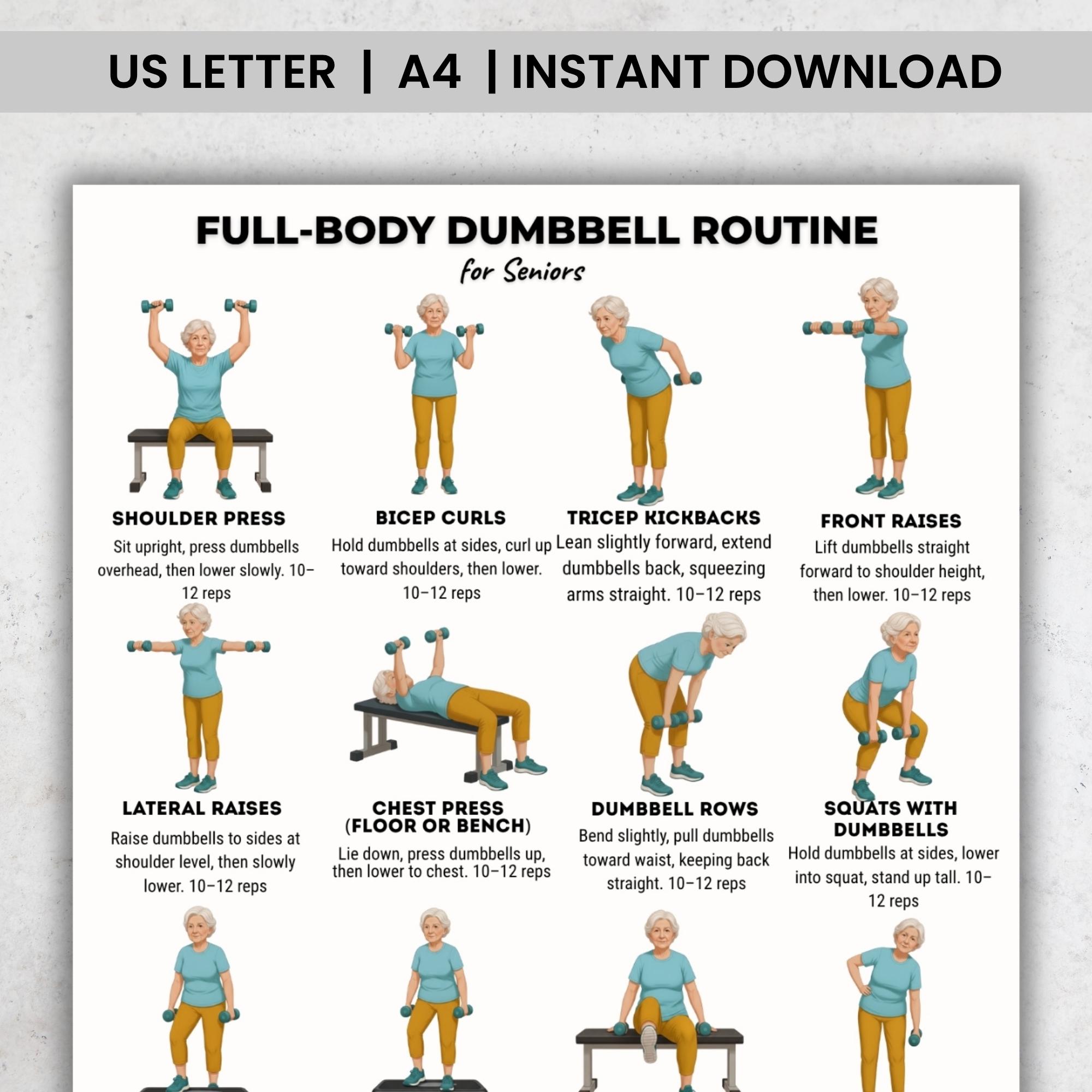
Consistency beats complexity. Use these structured plans to build strength safely with dumbbell exercises for elderly adults.
Try the “Essential 5” Routine
Best for building foundational strength.
Frequency: 2 to 3 times per week.
Rest: 1 to 2 minutes between sets.
- Goblet Squat: 10 to 20 reps × 3 sets
- Romanian Deadlift: 8 to 15 reps × 3 sets
- Step-Up: 10 to 15 reps per leg
- Dumbbell Row: 10 to 15 reps per side × 3 sets
- Squat and Press: 10 to 15 reps × 3 sets
Do the 10-Minute Full-Body Circuit
Perfect for beginners or low-energy days.
Format: 30 seconds work, 10 seconds rest. Repeat circuit 1 to 2 times.
- March in place (warm-up)
- Back Pull
- Bicep Curls
- Knee Raise (Right)
- Knee Raise (Left)
- Kickbacks
- Side Raises
- Side Leg Raise (Right)
- Side Leg Raise (Left)
- Rotator Cuff
- Hamstring Curl (Right)
- Hamstring Curl (Left)
- Heel Raises
- Front Raises
- Chest Press
- March in place (cool-down)
Use the 5-Minute Standing Routine
Great for busy days with no floor work needed.
Format: 30 seconds work, 10 seconds rest.
- Alternate Knee Raise with Curl
- Hamstring Curl with Kickback
- Side Leg Lift with Arm Raise
- Step-Up Chest Press
- Front Crunch
- Standing Twist
- Repeat top exercises
- Cool down with deep breaths
Prevent Injury With Proper Form
Technique is everything. Follow these biomechanical rules to stay safe during dumbbell exercises for elderly individuals.
Maintain Neutral Spine Alignment
Keep your spine long and flat in all exercises, especially during RDLs and kickbacks. Never round your back. Imagine a straight line from head to tailbone.
Engage Your Core Constantly
Tighten your abdominals in every movement to stabilize your torso and protect your lower back. Think “belly button to spine.”
Control Your Breathing
Exhale during exertion (lifting, pressing, pulling). Inhale during the lowering phase. Avoid holding your breath, as it can spike blood pressure.
Move With Slow Tempo
Aim for 4 seconds down, 2 seconds up in strength exercises. Slow movement builds control and reduces injury risk.
Respect Joint Limits
Don’t force range of motion. Raise arms only to shoulder height. Stop if you feel joint pain.
Integrate Strength Training Into Daily Life
Strength training works best when paired with supportive habits.
Protein Intake: Eat 1.0 to 1.2g of protein per kg of body weight daily. Examples: eggs, Greek yogurt, chicken, lentils.
Hydration: Drink water before, during, and after workouts. Dehydration increases fall risk.
Sleep: Aim for 7 to 8 hours. Muscles repair during deep sleep.
Consistency: Train 2 to 5 times per week. Even 5 minutes daily beats one long weekly session.
Modify When Needed: Use a chair for balance, reduce weight, or shorten range of motion. Safety always comes first.
Consult Your Doctor: If you have heart conditions, osteoporosis, or joint pain, get medical clearance before starting.
Frequently Asked Questions About Dumbbell Exercises for Elderly
What Weight Dumbbells Should Seniors Start With?
Most seniors should begin with 1 to 5 pound dumbbells, depending on current strength. The weight should allow you to complete all reps with perfect form. If you cannot maintain control or your form breaks down, the weight is too heavy. Water bottles or wrist weights work well for absolute beginners.
How Often Should Older Adults Do Strength Training?
Aim for 2 to 5 sessions per week, allowing at least one rest day between sessions. Consistency matters more than intensity. Even short 5 to 10 minute sessions performed regularly produce meaningful strength gains over time.
Are Dumbbell Exercises Safe for People With Arthritis?
Yes, when performed correctly. Use lighter weights, reduce range of motion, and avoid movements that cause sharp pain. Focus on controlled, slow movements and stop immediately if you feel joint discomfort. Consult your doctor before starting if you have significant joint issues.
Can Seniors Build Muscle After 65?
Absolutely. Research confirms that adults over 65 can build muscle through resistance training. While muscle growth may be slower than in younger adults, consistent dumbbell exercises for elderly individuals can reverse sarcopenia (age-related muscle loss) and significantly improve functional strength.
What Is the Best Exercise for Preventing Falls in Elderly?
Goblet squats, heel raises, and side leg raises are among the most effective fall-prevention exercises. They strengthen the legs, ankles, and hips while improving balance and coordination. Combining these with upper body work provides comprehensive stability benefits.
Should I Sit or Stand During Dumbbell Exercises?
Both positions are valid. Standing exercises better mimic daily activities and engage core stabilizers. Seated variations are excellent for those with balance concerns, joint pain, or limited mobility. Choose based on your comfort and